|
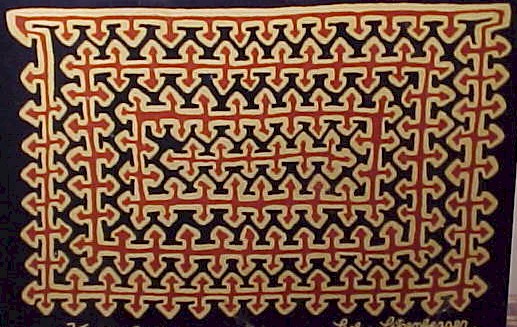
Kunayala by Lesley Hendricks, 1993 (12"x15") |
The Art of the Kuna
by Lesley Hendricks
As a textile artist I have long been fascinated by the colorful and symbolic molas made by the Kuna Indians of Panama. The mola first appeared in the second half of the nineteenth century. Before that women went around bare-breasted and painted their bodies. The Indian women either wanted to imitate Western-style clothing or were obliged to wear clothing by the new arrivals. They progressively developed not only an original garment that expressed their difference, but also new designs and a new play of colors. A pictorial language was born [Perrin, Magnificent Mola, p. 25].
The earliest molas tended to be intricate geometric designs done in two or three colors and were long garments that reached almost to the knees. The mola has evolved into a shorter blouse with puffy short sleeves with very colorful designs on both the front and back of the blouse. The Kuna women copy advertisements, pre-Columbian designs, or anything that catches a mola maker's fancy. Many molas are not incorporated into clothing, but are made strictly for the tourist trade.
The technique of constructing a mola is known as reverse applique. Instead of cutting out small pieces of fabric and sewing them to a base of fabric to make a design as in regular applique, the mola maker has layers of fabric. The design is drawn on the top fabric and the mola maker cuts through the top layer and sews it down exposing the color layer beneath. The stitches are extremely small and the raw edge folded under during stitching is 1/8 to 1/16 of an inch -- just enough to fold under the raw edge. On very colorful molas scraps of fabric are inserted and sewn down. The designs are embellished with small scraps that are appliqued on top and some molas also incorporate some embroidery.
In 1993 I went with a group of quilters to spend two weeks on the San Blas Islands where the Kuna Indians live. Our purpose was to learn to make a mola. The Kuna women are extremely shy around outsiders. Luckily we were accompanied by a Kuna woman who lived off island and facilitated our interaction. The Kuna were very curious as to what we would do with what we learned. Some were afraid that we would leave, start making molas, and put them out of business. After two weeks of sewing by kerosene lantern and trying to make stitches as small as the Kuna women could, I informed my hostess that there was no way she had anything to be worried about. The process is long and painstaking and I was amazed by how fast Kuna women could sew a mola.
I have made several textile pieces incorporating the mola making technique of reverse applique. This first one is a copy of a very old mola that one of the Kuna women had in her hut. She graciously traced the pattern onto tissue paper so I could attempt to make it. The result which I named Kunayala (Land of the Kuna) turned out "just okay" because when examined very closely there are a lot of frayed edges which are not evident on the original. The top layer is black, the middle layer is red, and the base fabric is yellow.
|
Kunayala by Lesley Hendricks, 1993 (12"x15") |
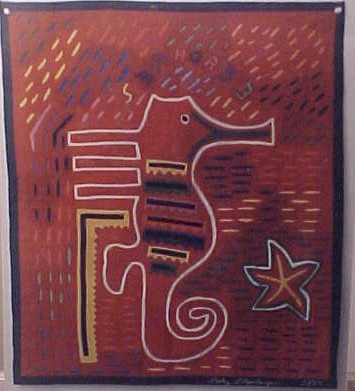
This next piece Seahorse for Berit is a wall hanging and was my very first attempt at reverse applique. The base layer is white and the top layer is red. Scraps of fabric were inserted between these two layers to get the colorful effect. The inverted "L" and embellishments on the body of the sea horse are appliqued.
|
Seahorse for Berit by Lesley Hendricks, 1982 (24"x36") |
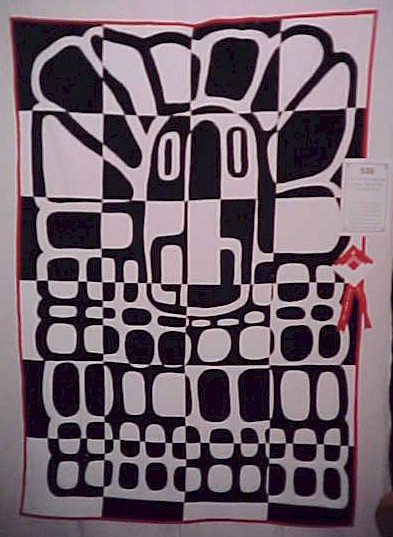
This next work is a copy of a small doodle (4'x5") done by a friend as he spoke on the telephone. I studied it for a while and decided that it would work nicely as a wallhanging. I blew the doodle up by xerox enlarging.
|
Doodle Magnified by Lesley Hendricks, 1996 (48"x60") |
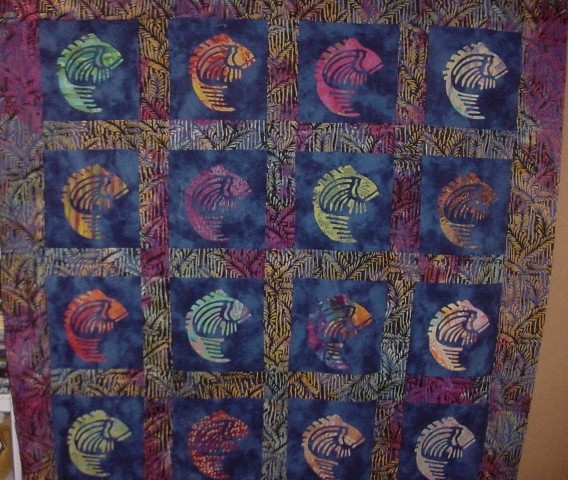
My most recent reverse applique work is taken from a pre-Columbian design of a fish. Each fish took about four days to stitch. This is a work in progress and is not yet completed.
|
Pescao! by Lesley Hendricks, 2002 (51"x51") |
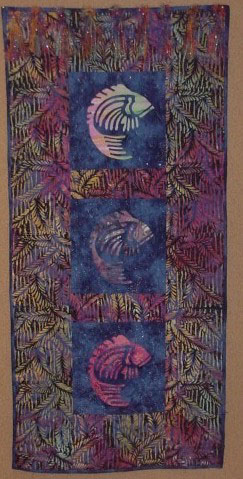
I had sewn three more fish than I needed for this work so I incorporated them into a small wallhanging.
|
Wicked Seaweed by Lesley
Hendricks, 2002 |
For me molas are an intricate folk art. Each panel made is different and unique.
The subject matter incorporates nature, social commentary, political commentary,
and whimsey. Having tried my hand at "mola making" I know exactly how
talented and innovative the Kuna Indians are in their art.
________
Bibliography:
Perrin, Michel. Magnificent Molas. Flammarion Press, Paris.
1999.
All photographs are copyrighted by Lesley Hendricks. Reproduction by any method is prohibited without the written authorization of the photographer. |