|
The Sanitarium at Taboga
Its History and Uses - Attractions of the Island
by David A. Laing
|
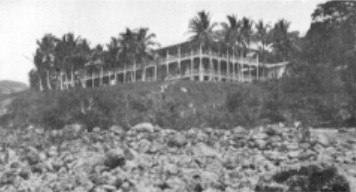
Isthmian Canal Commission Sanitorium - Taboga Island |
The Sanitarium on Taboga Island was
established by the old French Canal Company in 1885 as a convalescent hospital for the
French employees then working on the Isthmus. After the abandonment of active
operations on the Canal, the representatives of the French company allowed residents of
the Isthmus to use the Sanitarium building as a boarding place for visitors. The
attention of the French officials was first called to the salubrity of the island of
Taboga by the fact that residents of the Isthmus had for many years visited there and
considered it a very agreeable change from the relaxing climate of the mainland. It
is a well known fact that the rainfall at Taboga is only about one half what it is on the
Ancon side of the Isthmus, while conditions show that the atmosphere is at all times very
much drier and the climate much more bracing.
After the transfer of the Canal works to the administration of the United States, one of
the first orders given by the hospital division was for the rehabilitation and
reorganization of the Sanitarium at Taboga. The work was completed and the
Sanitarium re-opened in September, 1905. Since that date extensions and improvements
have been made about the building and grounds.
The present normal capacity of the Sanitarium is seventy patients, with an emergency
capacity of ninety.
The system employed is to transfer the convalescents from Ancon and Colon Hospitals, and
when they so desire, and there are accommodations available, to allow their families to
accompany them. At times also, employees and their families are sent there on the
recommendations of an I.C.C. physician without first entering the hospital. when
conditions permit, employees who so desire, are allowed to spend portions of their
vacations at the Sanitarium. The same is true of honeymoons. The Sanitarium is
in the charge of a Superintending Physician, three nurses, and a steward, assisted by a
staff of colored cooks, attendants and waiters. Patients are transferred to Taboga
by the hospital launch which makes tri-weekly trips. On this launch supplies from
the Commissary are also shipped. considerable amounts of milk and fresh fruits are
purchased on the island for the use of the institution.
En route to Taboga, passengers obtain a very good view of Panama City and Ancon,
the Pacific entrance to the Canal at La Boca, the leper settlement at Palo Seco, and the
islands of Naos, Culebra, Perico and Flamenco. These islands are now the property of
the United States and on one of them, Culebra, quarantine headquarters for the Pacific
side of the Isthmus will be established.
Near the island of Perico may be seen the masts of the ship Lautaro which was set
fire to and sunk in January, 1902 by the Liberty gunboat Padilla during the last
revolution. General Alban, the Colombian military chief of the province of Panama
lost his life in this action, along with two or three hundred Colombian soldiers, many of
whom were buried on the island of Flamenco close by.
|
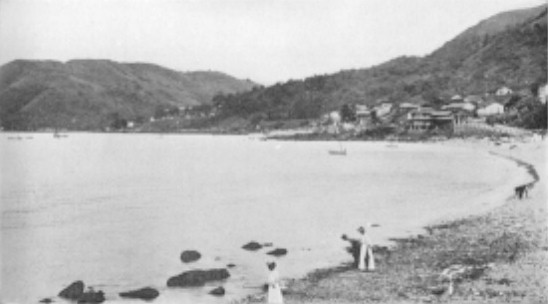
Taboga Island's Horseshoe Bay - circa 1914 |
Taboga Island is about four miles long
and two miles broad, and is ten miles from Panama City. On his arrival the visitor
is impressed with the extreme clearness of the sea water, the atmosphere, and with the
many different shades of green that are to be observed on the sides of the hills.
The village of Taboga is ideally located on a horseshoe bay and is said to have been in
existence at the same time as Old Panama. In the village there is a small, old Roman
Catholic church that is a point of interest to visitors. The floor of this church is
paved with tombstones and memorial stones, many of them bearing dates during the
eighteenth century.
The sea bathing is very good, especially on the section of beach that forms the bar
between Taboga and Morro islands. About half a mile above the village there are also
fresh water bathing pools which are supplied by the stream coming down the ravine in the
center of the island.
The climb to the top of the hill behind the village is well worth the exertion involved.
The path follows the stream for about a mile and then branches off through several
pineapple and corn patches to the top of the hill, whence a magnificent view of the whole
of Panama Bay and the mountains of the Isthmian mainland can be obtained.
Plantations of pineapples, oranges, limes, mangoes, mameis, cocoanuts, corn and coffee are
tended by the natives. The pineapples of Taboga are famous for their lusciousness.
Others of the natives make their living as fishermen and boatmen. Taboga
spring water is well known up and down the west coast. The steamship companies
running into Panama obtain water there which is used by their boats while on the trip to
San Francisco or Valparaiso.
The Pacific Steam Navigation Company at one time had machine shops and storehouses on
Taboga Island for the purpose of handling repairs and victualling their steamers plying up
and down the coast.
Their headquarters were moved to Callao and later to Valparaiso, but they still dock and
repair their small local coast steamers at Taboga.
[Ed. Note: This article was written over 90 years ago. The Sanitorium is long gone; however, Taboga Island continues to be a place where one can visit and enjoy the peacefulness offered -- the author's description of the island sounds very much as the island is today.]
from: The Canal Record,
January 15, 1908
CZBrats
October 16, 1999
Click Button To Return To Previous Page