|
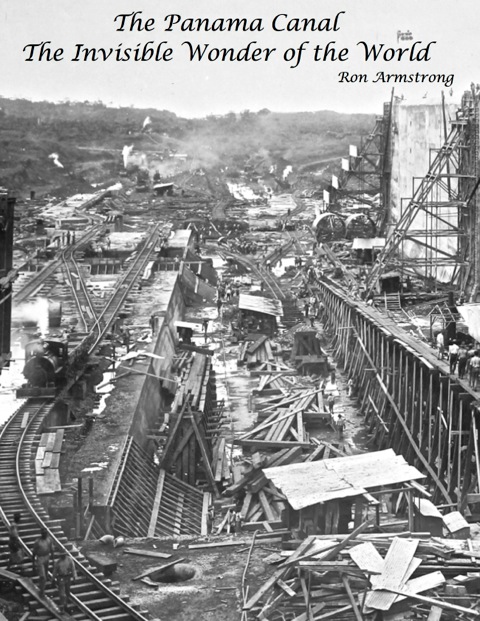
“The Panama Canal: The Invisible
Wonder of the World” by Ron Armstrong
Mr.
Armstrong has written a very good book on the Canal. It contains
photographs from the Archives of George Goethal’s collection at West
Point. Some photos you haven’t seen before. This book is a great
edition to your Panama Canal collections.
This book is currently available for your iPad via iBooks and soft cover from http://theinvisiblewonder.com
From the Introduction:
This book is a pictorial history of
the construction effort to build the Panama Canal. It is not about
the politics, disease, mosquitos, intrigue, treaties, the other
possible locations for such a canal and a host of other peripheral
subjects. All these various topics readily lend themselves to
written descriptions and there are literally dozens of books that
describe those subjects very well indeed.
It is
virtually impossible to do justice to the effort in written word.
This book is intended to give the viewer a hint of the massive
effort that today goes mostly unseen. It is primarily about the
American construction but includes a bit of the failed French
efforts. A good deal of the French effort was used, by the
Americans, to advantage but much of it was for naught since Gatun
Lake covered it forever. The French excavations in the Culebra Cut
were not in vain. They reduced the American effort yard for yard.
Generally the book follows a traveler transiting from the Atlantic
to the Pacific. Within the sections described on page 4, the photos
are loosely arranged by date or place within the section. Precise
chronological order is impossible because of the time sequences of
photos taken from a particular place.
On the
back cover and page 1, is a 1913 quote from J. Saxon Mills. There
is another quote, of a similar nature, on page 85, by “Zone
Policeman 88”, Harry Alverson Franck, from his 1914 book “Things
as They are in Panama.” Those comments were brought home by a
friend who said of a recent transit, “There wasn’t much to see.”
This book, hopefully, will help to readers to overcome such
expressions. It is my desire that the traveler will realize a bit
of the effort expended to make smooth sailing between two continents
possible.
Up to
50,000 men were working at one time. The number who spent some time
working on the canal is unknown. 22,000 laborers died under the
French effort, mostly to disease. Most of their grave markers are
numbered without their names. Under the Americans, over 5,000 died,
mostly to accidents. Everyone who worked for any time on the canal
lost friends and coworkers. In total, 27,000 men died, that is over
540 per mile, or one for every 10 feet from deep water to deep
water. For a little more perspective consider that in the length of
an average cruise ship, 100 workers died, ship length by ship
length, for the 50 miles. Such sacrifice begs that people using the
canal should remember the effort for many millennia, but in less
than a lifetime the memory has faded to a blurred dream.
Work
continued from 1881 until 1914 when the first large ship traversed
ocean to ocean. No sooner had ships begun to pass through the canal
than slides, of massive proportion, completely blocked it, on more
than one occasion. As the mountains slid into the canal, the
attitude was “We’ll just keep moving earth until the mountains run
out of rock.”
The
cost of the Canal was staggering but none of reputation could hold
that the expense was not worth it. Today, most of the ships on the
seas are not built larger than the Panama Canal will allow. Ship
owners rarely build a ship over the 1000’ long and 106’ wide, thus
allowing them to pass through the locks. Ships of that size are
called Panamax Ships.
The
cost of original construction was $350,000,000 but keep in mind that
those were gold dollars at $20 per ounce. In 2012 with gold at
$1600 per ounce that figure would be $28,000,000,000 or over a half
billion dollars per mile.
This
book is dedicated to the men of every race, religion, color, and
creed who labored to make the Panama Canal possible. For that
reason there is no discussion of any other aspects of the canal.
|