Baby Crocs
by Lou Womack
The Hyacinth Control
Station was located up inlet on the Chagres River across from Gamboa. Dad was
foreman and each morning he would assign the men their work for the day. The usual task
was to have the men get into their respective rowboats, called pangas, with their lunches
and machetes. Then they would attach one rowboat to another and make a long string of
rowboats which in turn was connected to the launch. Each morning the launch would haul
them up the Chagres River to the islands of hyacinth. One by one they would release
their boat from the one in front them and spend the day chopping up the hyacinth, hauling
it into the boat, and then row over to the shoreline and dump it.
The hyacinth plant grows on top of the water like a water lily does and can rapidly fill
up an inlet. They grow as big as small islands if not controlled. The hyacinth had to be
controlled because during the torrential rainfalls these plant islands would break loose,
float into the Panama Canal and then tie up ships' propellers. Sometimes logs were chained
together across small inlets to hold back the hyacinth.
For twelve years Dad and his faithful employees worked daily in this archaic method of
controlling the hyacinth. Years later manatees were introduced as a form of control
and then defoliants. There is now a new device used called a dragline. All I know is that
Dad’s method worked well for those all of those years because I don’t ever
recall a single incident of hyacinth tying up a propeller of a ship near the Chagres
River.
| Across the inlet from the Hyacinth Control
a mother crocodile had laid some eggs. I guess she thought it was a very private
place, but actually it was the center of activity every morning for the employees. One of
the men on the work force spotted the crocodile while loading up for the morning and word
got around fast. Upon hearing the news, I got very excited and had to see the nest, so Dad
took me over there and we dug up some eggs. What a strange sensation it was for me to
handle these rubbery, flexible eggs that wiggled a little bit. There might have been some
noise or the noise might have come later on when their little noses peeked through the
skin. I wondered where the mother crocodile was while this was going on. Naturally
we redeposited them back in their nest and waited for them to hatch. |
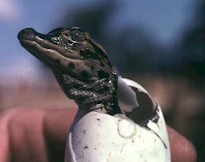
Just Hatched!
|
One bright sunny day,
“Walla!”—I was the proud recipient of some baby
crocodiles when Dad came home that night. Now the question arose from Mom,
“Where shall we put them?” I am sure Dad had considered this question
before arriving home so his immediate response was, “How about the maid’s shower
in the basement?” Mom was relieved that they wouldn’t be living in our midst
inside the apartment. She and I had already experienced the tale of the missing boa.
Dad taught me to pick up the crocodiles from the back of their neck so that they
couldn’t bite me. I will always remember being told that it takes a lot of effort on
the crocodile’s part to open its mouth but once its open, “Pow!” It
doesn’t require any strength and comes down fast and very forcefully. Needless to
say, I obeyed this instruction and was never bitten, even when I would tote them from the
shower to the tubs in the basement where I would watch them swim around in the water with
their little feet.
However, this playtime with my new found friends only lasted for a few days. Mom
soon found out that the horrible odor coming from the shower was from the rotten hamburger
the little crocs had been fed. Her order was, “Back to the jungle with the
crocs!”
CZBrats
February 19, 2000
Click Back Button To Return To Previous Page